Why ‘AD’ is not always the answer: how to use common sense about the new guidelines.
Happy Sunday everyone!

I am in no way qualified in this area but I do think after reading the guidelines carefully; there’s been a lot of misunderstanding and we need to just chill out a bit.
So I am going to explain best I can; referring only to the up to date guidance we have which is the new social media endorsement document by the CMA(this is the organisation that has actual legal powers to enforce the rules) and the influencer guide by ASA (this organisation seems to not have legal power; their sanctions, which they say they don’t like to use, is referring to other bodies).
ASA doesn’t currently have any power to make them to (they ‘like to resolve issues informally’). CMA are now saying they have powers; but then listed 16 bloggers that they could have pressed charges again but instead made them promise to change.
I am not trying to be sarcastic about these organisations, but just that I think it is important to get a bit of perspective. The main reason many big bloggers are continually not to disclose content is simple: because they can get away with it.
This does not fill me with confidence and I personally think rather than updating the rules yet again-time would be better spent actually coming up with proper sanctions in the first place.
Either way, it’s important to note if you make a genuine mistake, you ARE NOT going to find yourself taking
Ok, so what do I have to use AD for?

The ASA defines an advertisement as either…
— the company has ‘paid’ you in some way
(can be freebies, doesn’t
have to be money),
—AND had some form of editorial
‘control’ over the content,
including just final approval.
Control doesn’t have to only be final approval; it can be as simple as ‘use this hashtag’; ‘we will gift you XX in exchange for XXX’ or ‘please post by this date.’
So, in the case, there is some confusion over gifted items and I think this could change the way we work with brands. Because for a long time now people have been essentially running paid campaigns in the same way as gifted campaigns (but not disclosing as such) -and we need a distinction.
You do need to start seeing items as ‘payment in kind’ if you’re agreeing to certain terms and conditions; because they are! And that has tax implications too! (but that’s a whole other post).
For one, perhaps its time NOT to accept every PR sample offered. I personally, very rarely agree to any kind of coverage when someone offers to send me a product and I’ll be honest and say if it’s not for me. I prefer to have a handful of long-term relationships rather than mention tons and tons of things!
So it could be worth thinking about what you agree to do upfront and making this clear. Explaining you only offer content approval or guaranteed coverage for paid campaigns. Lately, I’ve been asked by brands to give something a try and if I like it, come back with a proposal on how we could work together. I really like that organic way of working.
So yep it doesn’t matter if it’s £500 or a chocolate bar; if you’ve agreed to conditions in return for the item: it’s an AD. So use this to really think about how you work with brands! E.G. Stop agreeing to write a blog post in exchange for a bowl of sugar puffs! (actually accurate!)
A final note: the new guidance says this must go at the START of the post; so no more hiding AD at the bottom.
But now you have to declare ANYTHING GIFTED as an Ad don’t you?

That’s where the confusion lies and people have interpreted this differently. There has to be both (PAYMENT/GIFT and CONTROL) to come under ASA. So what about that random PR parcel you received in the post? Or the brand that offered to send something but you’ve been pretty bloody clear that you aren’t agreeing to anything upfront?
Well ASA says it’s nothing to do with them, quote: “consumer protection legislation still applies but this is now enforced by the CMA.” They do suggest you use a disclaimer SUCH AS advertisement, but given its not their area (and ‘such as’ is not definitive’)-we actually need to see what CMA says-since this is their remit.
-“If you’ve received something ‘out of the blue’ it still counts as payment it was sent with the hope you’d feature.”
(A stretch but ok!) And then this what it says…
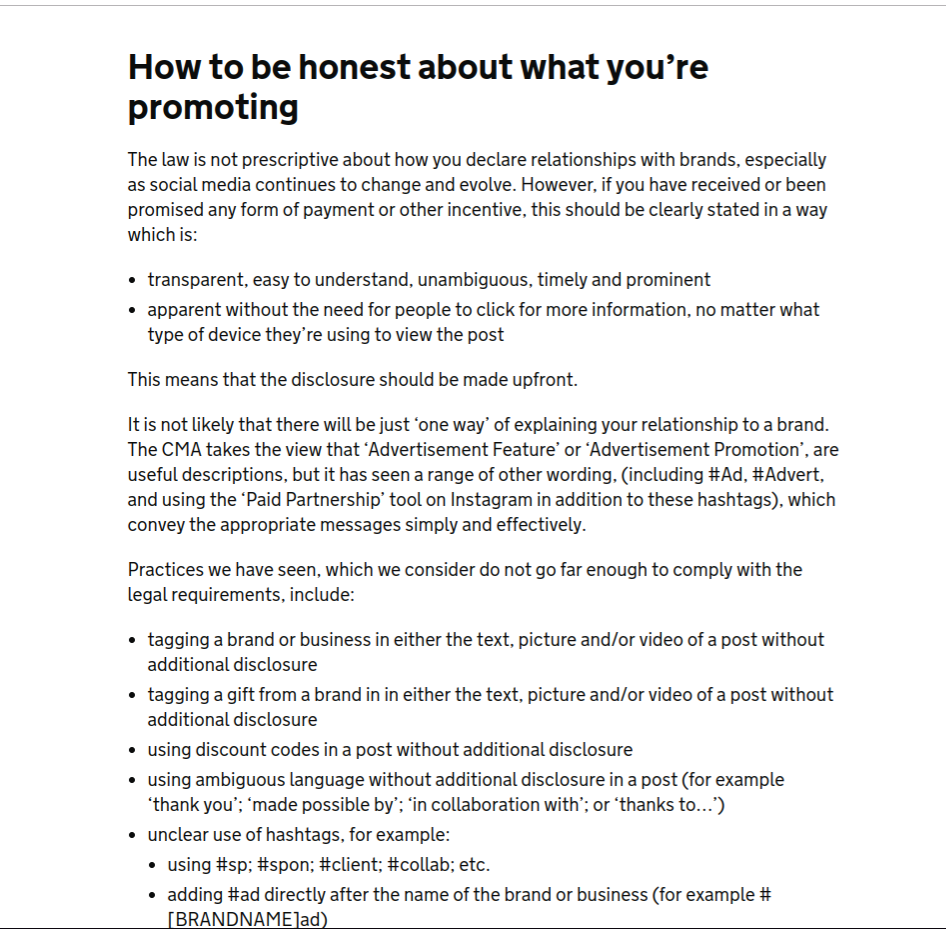
So in other words, if it is a freebie (regardless of the control part): you need to make that clear. Please tell me where, in this guidance, it says you have to use AD in this situation? In fact, the key takeaways here are: ‘The law is not prescriptive about how you declare relationships with brands.’ and there will not be just ‘one way of explaining it.’
I do not believe a product sent with no expectation is the same as an AD- but I do have a responsibility to make this clear and not use vague language. Interestingly, gifted is not included in their examples of vague language (make of that what you will)
Here, CMA is acknowledging it is complicated and trusting you to READ the guidance and come up with language that WORKS FOR YOU that of course complies with their guidance.
And that perhaps there are shades to this: being gifted a trip to the Maldives for 2 week’s worth of Instagram coverage is not the same as a chocolate bar arriving at your door. So how does using GIFTED for both help?
However, whichever way you’re disclosing it needs to be: UPFRONT (e.g. at the start), NOT AMBIGUOUS (so not vague like . ‘thanks so much to xxx…’ without saying what you’re bloody thanking them for! For the music? For a product? Or just for existing? ) EASY TO UNDERSTAND and PROMINENT (in other words, don’t be a sneaky bitch and put it in font 8 or in the middle of the caption!)
Many times, AD will be the easiest and most recognisable way to do this. Other times, not. For example, I was speaking to a blogger who said she still didn’t want to put AD for complimentary holiday so was planning to write *Hotel stay provided for free of charge in exchange for coverage on Instagram* at the top of her post.
At first, I thought ‘hmm’ but actually I think she’s right: can you actually argue with that? Would they take action for that? It is incredibly clear what the deal is here (more so, than putting ad even) and she’s met all of that criteria-she is not misleading her reader and she is agreeing with the CMA that there is more than one way to disclose (P.S. If it was me, I’d probably still put AD too but that’s a mute point as no one bloody invites me on holiday)

So perhaps what this does do is to get us to think more extensively about the disclaimer we use. If you put GIFTED at the top of a post standing a hotel room, how do I know if that’s the clothes you’re wearing, your lipstick or the room? Here, a hashtag really doesn’t work that well at all. It is not compliant as it is not clear enough.
Similarly, as a food blogger who writes and reads a ton about gluten-free, it is important for me to know if a blogger is saying ‘OMG this tastes amazing’ because they’ve been paid for it, or if they received it randomly to try in the post. NOT MAKING that distinction by labelling everything AD is not being transparent and clear for me as a reader. To me, that’s not compliant either!
Perhaps this is less the case for fashion and other sectors? But my readers deserve to know if actually, I tried something that came in the post and loved it so much I spent my time making a five-minute video on it off my own back- because that distinction is important! And if it means writing lengthier disclaimers at the top, so be it!
If you feel AD still applies here, then use AD-gifted or AD-unpaid but contains gifted content. That’s clear enough right? Don’t just blanket AD
Yes but don’t past relationships have to be disclosed with AD too?

Yep, you do need to disclose. And you can see what I have screenshotted above. Again, it doesn’t have to be this difficult! You just need to make clear you’ve worked with a brand in the past and not hidden. I’ve just realised I cut
So, if you do an Instagram post containing a coat you were gifted six months ago, then, to me, having ‘contains previously gifted items’ is a clear disclaimer that correctly interprets this guidance. When talking about the items in the picture; again Still loving my coat (previously gifted by xxx).
If it’s a completely new item you’ve purchased yourself with no incentive but have worked with a brand before, again common sense here.
ASA actually says…
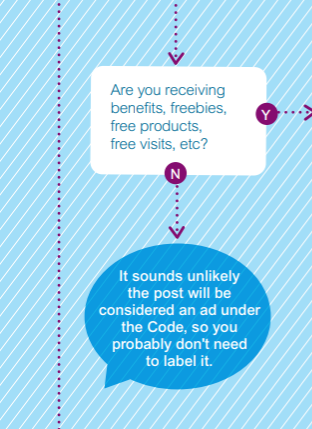
However, CMA doesn’t actually specify about that at all (helpful).
I did question a blogger on Instagram who said she was going to label everything AD if she’d bought it but was paid/gifted in the past- and said she’d spoke to CMA who had said it was ‘best practice’ to do so as you could be trying to influence the brand to work with them again by mentioning them.
Now that really is a stretch
However, I would argue ‘best practice’ is open to interpretation and it says absolutely nothing about having to do this in their guidance. I respect people’s opinions on this but here is the time to take a bit of ownership for our content and an open relationship with our reader and I will be going by the clear, written guidance until told otherwise.
However, if you’re worried, If I was doing an Instagram story about my weekly shop and it included something I’ve bought from a gluten-free brand I’ve worked with in the past simply station ‘You know I’ve worked with X before and love their stuff, I bought
Or to be honest, if it’s stressing you that much just don’t mention the brand again! In an Instagram story or a blog post, you can communicate this much more clearly than a standard Insta or twitter post where captions are limited. So stick to where you can explain yourself properly in my eyes!
I think this is something that will be updated in months to come because I imagine it is almost impossible to enforce (since you literally have to prove an intention) or indeed monitor. So I will put the date at the bottom of the post and update if needed.
What about Megan from Love Island?
Yes, I know. It’s annoying. She posted a picture in some very tight trousers that was clearly an AD for Pretty Little Thing and didn’t disclose it. But to that I say two things: since when did we hold Megan from Love Island as a peer and someone setting best practice? Everyone seems to have forgotten what she did to Laura but I remember it and I’m still furious
And secondly, it’s like when I was and, seriously, it’s Megan from Love Island.
A few more points
-ASA is saying you need to put AD in front of your own product. It’s a bit random but it is super clear on that so you can’t really argue with it. I don’t really promote my ebooks but I will use something like ‘AD-my own ebooks’ if I do on twitter (I don’t have an
–If a post contains affiliate links (say if I list a really helpful book at the end of this guide) the whole thing is not an AD. If the whole post is centred around the affiliate link, like I was reviewing the book in-depth: it technically should be. Must admit, I need to go back and change the one or two reviews I’ve done that contain an affiliate link to comply here and will do so! I’ll put ‘AD-Affiliate’ to compy here.
– Vix Meldrew has also written a very useful post about this. I didn’t actually read it until I was almost finished this and thought *shit, what if I am saying something completely wrong. here!* Thankfully, she seems to hold a similar stance-but we disagree on whether AD applies to a gifted item with no expectation. I’ll leave you to read the guidance yourself and decide (sidenote: I really like her blog and exciting emails podcast! It’s fab)
Right, that’s it! Look, who remembers a year or so back when everyone kept saying you were going to be fined a million pounds unless you deleted your email list and I mentioned that IT WASN’T GOING TO HAPPEN. To chill out, read the guidance and apply some common sense.
I’m not saying I’m psychic or anything but chances are you WEREN’T
Disclaimer: This is my own opinion based on new guidance. It was written on the 27th January 2019. I will amend if policy changes or I am informed differently and amend my own disclosure policy accordingly.
–
Thanks for this, it was really useful. I’ve been trying to get my head round it since it was announced. The only thing I’m now stuck with is how to declare an event I went to! No pressure to post about the event or the products given but I want to and I’m now stuck. I think it may just need a little sentence to say I was invited along, kinda like the holiday example?
Lauren 🙂 x
This is really useful, thanks Jenna. I am still a little bit confused so I think I will do some more reading. It’s just not easy when everything is not that clear.